When it comes to protecting a commercial facility, the roofing system plays a critical role in safeguarding the building, equipment, inventory, and daily business operations.
At Roofing Solutions NC, we understand that commercial roof replacements require more than installing a new membrane. They demand careful planning, thorough inspections, proper drainage design, and attention to the details that affect long-term performance.
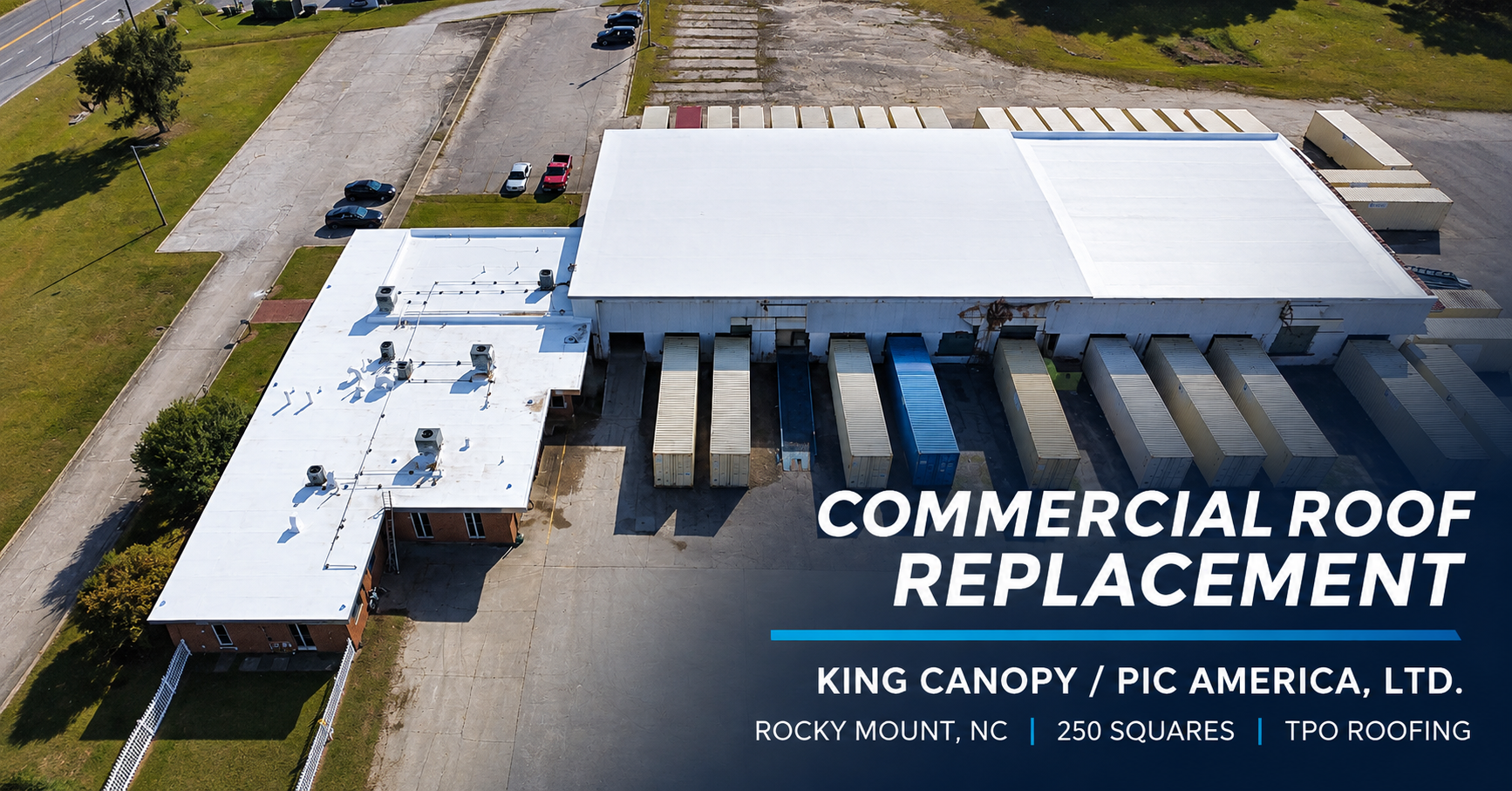
Our commercial roofing team recently completed a major roof replacement project for King Canopy / PIC America, Ltd. in Rocky Mount, North Carolina, replacing approximately 250 squares (25,000 square feet) of aging roofing systems with a new TPO commercial roofing system. Led by Jarrett Henderson, our commercial roofing team developed a comprehensive replacement plan to address the building's existing roofing conditions and provide a more consistent, durable roofing system.
The Challenge: Three Aging Roofing Systems on One Commercial Building
The King Canopy facility presented a unique challenge because the building had three different types of existing roofing systems.
- Exposed-fastener metal R-panel roofing over the warehouse.
- Aging EPDM rubber roofing on the rear section.
- Foam-coated roofing over the office area.
Each system had developed its own set of problems over time. Rather than continuing to make isolated repairs across multiple aging roofing materials, the project called for a comprehensive replacement designed to address the building as a complete roofing system.
Deteriorating EPDM Roofing
The existing EPDM roof had reached the end of its useful service life. During our inspection, we identified deteriorated seams, punctures, membrane tears, and aging flashing details. The parapet wall flashing also showed signs of rust and deterioration. These conditions created multiple potential pathways for moisture intrusion, making replacement the more practical long-term solution.
Aging Metal Roofing and Failing Fasteners
The warehouse's existing metal roofing system had experienced numerous repair attempts over the years. Our inspection identified several areas of concern, including rusted fasteners, deteriorated or missing sealing washers, screws backing out of the panels, and gaps at metal panel overlaps. Portions of the metal panels and perimeter trim were also beginning to rust. Exposed-fastener metal roofs rely heavily on properly functioning fasteners and sealing components. As those components deteriorate, the number of potential leak locations can increase substantially.
Deteriorating Foam Roofing Over the Office
The office section had an existing foam-coated roofing system that was showing significant signs of deterioration. The coating had broken down in multiple areas, and several roof penetrations and drainage locations required attention. Because the existing material had deteriorated extensively, removal and replacement were included in the project scope.
The Solution: A New 60-Mil TPO Commercial Roofing System
After evaluating the existing roof conditions, Roofing Solutions NC developed a replacement plan using a 60-mil Mule-Hide TPO roofing system. TPO, or thermoplastic polyolefin, is a single-ply roofing membrane commonly used on commercial and low-slope buildings.
It offers several important advantages for commercial property owners, including:
- Heat-welded seams that create strong, watertight connections.
- A reflective white membrane that can help reduce solar heat absorption.
- Resistance to ultraviolet exposure and normal weathering.
- Flexibility to accommodate ordinary building movement.
- A roofing system designed for commercial low-slope applications.
For the King Canopy facility, TPO provided an opportunity to replace three aging roof assemblies with a more consistent roofing solution.
How the New Commercial Roofing System Was Installed
A successful commercial roof replacement begins long before the new membrane is installed. For this project, the installation plan addressed roof preparation, insulation, drainage, membrane attachment, and flashing details throughout the facility.
Removal of the Existing Roofing Materials
The first stage involved removing the existing roofing systems across the three primary sections of the building. This included the old EPDM membrane, exposed-fastener metal warehouse roofing, and deteriorated foam-coated office roofing. Once the existing materials were removed, the roof substrate could be cleaned and evaluated. Any damaged or unsuitable decking would need to be addressed before installation of the new roofing assembly.
Installation of Polyiso Roof Insulation
The replacement system included polyisocyanurate (polyiso) insulation across the three roof sections. Polyiso is commonly used in commercial roofing because it provides thermal resistance while supporting the roofing assembly. The installation also required careful planning around rooftop equipment, mechanical units, and existing penetrations.
Improving Roof Drainage
Proper drainage is one of the most important aspects of any low-slope commercial roofing system. During the initial inspection, our team evaluated the building's existing drainage configuration, including the scuppers along the rear warehouse section. The replacement plan incorporated tapered insulation and roof crickets where needed to direct water toward designated drainage locations. The scope also addressed restoring drainage openings affected by the deteriorated foam roofing and installing new scuppers where required.
Installing the 60-Mil TPO Membrane
With the substrate prepared and insulation in place, the new 60-mil TPO membrane was mechanically attached using appropriate roofing fasteners. The membrane sheets were then joined using heat-welding equipment. Unlike systems that depend primarily on adhesives or sealants at membrane seams, TPO uses heat to fuse adjoining membrane surfaces. When installed correctly, these welded seams form strong, continuous connections that help prevent water intrusion.
Flashing Roof Penetrations and Transitions
Commercial roofing systems contain numerous areas that require specialized flashing details. At the King Canopy facility, these included rooftop equipment curbs, plumbing penetrations, parapet walls, roof drains, and transitions between different roof elevations. The installation scope included TPO flashing at these locations, along with termination bars and perimeter edge metal where required. The new TPO system was designed to wrap key transitions, helping eliminate vulnerabilities associated with the previous metal trim and wall flashing configuration.
Why TPO Was a Good Choice for This Commercial Facility
Commercial property owners need roofing systems that provide dependable protection while remaining practical to maintain. For a facility with approximately 25,000 square feet of roofing, the long-term performance of the roof can have a significant impact on building operations. The new TPO system offers several advantages over the deteriorated assemblies it replaced.
A More Consistent Roofing System
Replacing the aging metal, EPDM, and foam-coated roofing with a unified TPO system reduces the complexity of maintaining multiple roof covering types.
Reflective Roofing Materials
White TPO membranes reflect a portion of incoming sunlight, potentially reducing rooftop surface temperatures during hot North Carolina summers. Actual energy savings depend on insulation, building conditions, climate, and HVAC operation.
Heat-Welded Seams
Properly heat-welded TPO seams provide durable connections that are important for long-term resistance to water intrusion.
Manufacturer Warranty Options
The project was specified for a 20-year Mule-Hide No Dollar Limit (NDL) roofing system warranty, subject to manufacturer inspection, approval, and issuance. As a Mule-Hide Certified Contractor, Roofing Solutions NC can install qualifying systems for this type of manufacturer-backed coverage.
Commercial Roofing Requires Experience and Attention to Detail
Replacing a commercial roof of this size requires coordination between sales, production, installation crews, and project management. From removing existing roofing materials to evaluating drainage and installing the final membrane, every phase contributes to the overall performance of the completed system. At Roofing Solutions NC, our commercial roofing team emphasizes proper installation practices, documentation, jobsite safety, and quality-control inspections. For the King Canopy project, the replacement plan was designed around the building's existing conditions rather than relying on a one-size-fits-all roofing approach.
Thank You to King Canopy / PIC America, Ltd.
We appreciate the opportunity to work with King Canopy / PIC America, Ltd. on this commercial roofing project in Rocky Mount, NC. We also recognize Jarrett Henderson and our commercial roofing team for their work in evaluating the existing roofing conditions and developing the replacement solution. Projects like this demonstrate the importance of identifying underlying roofing problems and selecting a system designed for the building's long-term needs.
Interested in commercial roofing? Learn more about our commercial roofing services or contact Jarrett Henderson directly to discuss your project.
Need a Commercial Roof Replacement in Eastern North Carolina?
If your commercial building has an aging metal roof, deteriorating EPDM membrane, recurring leaks, or a low-slope roofing system nearing the end of its service life, Roofing Solutions NC can help. We provide commercial roofing inspections, repairs, and replacement services throughout Rocky Mount, Greenville, Wilson, New Bern, Jacksonville, and surrounding North Carolina communities.