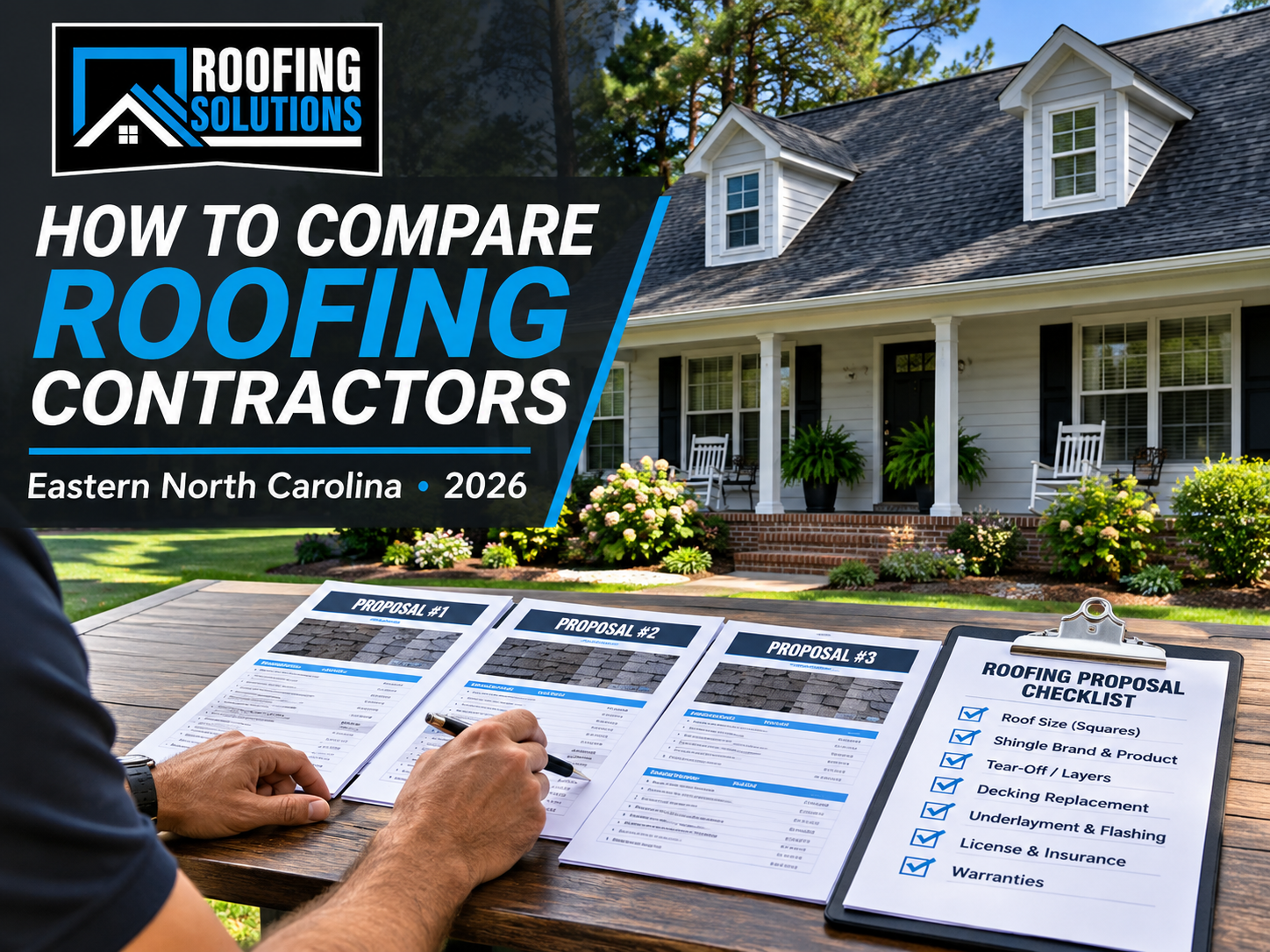
To compare roofing contractors, start by making sure every proposal covers the same scope of work. That means the same roof size, materials, tear-off and flashing. Then check each company's North Carolina license, its insurance and its warranties. The lowest price is only a good deal if all three bids match on scope.
Most homeowners in Eastern North Carolina collect two or three roofing proposals and then get stuck. One bid is thousands lower, another lists brands you have never heard of, and a third is a single number on one page. This guide walks you through how to line them up side by side — written for homeowners in Greenville, Jacksonville and the surrounding counties, where hurricanes, coastal wind and insurance claims make a few details matter more than they do elsewhere.
How Do I Compare Local Roofing Contractors?
Compare local roofing contractors on five things: a real local office, a North Carolina license, proof of insurance, a long record of local reviews, and an itemized written proposal. A contractor who has worked in your area for years and will still be here to honor the warranty is worth more than the lowest bid from a company that just arrived after a storm.
The NC Department of Justice advises homeowners to choose local companies with good reputations, ask for local references and look up online reviews.
Confirm they are actually local
- Look for a physical office address in your area, not just a phone number or a P.O. box
- Check their Google Business Profile for a local address, photos of local jobs and how long the profile has been active
- Ask how many years they have worked in your county — in Eastern NC, a contractor who has been through several hurricane seasons knows local wind requirements and local insurance adjusters
Compare reviews the smart way
- Read reviews on Google, the Better Business Bureau, Facebook and Nextdoor — not just one site
- Look for steady reviews over several years, not a burst of reviews in one month
- Read the negative reviews and see how the company responded — a calm, specific reply that fixes the problem is a good sign
- Look for reviews that mention your town, such as Greenville, Winterville, Jacksonville or Richlands
Ask for local references
Ask each contractor for two or three customers near you who had similar work done in the last year or two. Drive by the homes if you can. Call at least one and ask whether the crew showed up on time, cleaned up and handled any problems after the job.
Ask who will do the work
Ask whether the company uses its own crews or subcontractors, who will supervise the job day to day, and who you call if the roof leaks next year. A local contractor should give you one name and one number.
Once you have narrowed your list to two or three local contractors you trust, use the steps below to compare their proposals line by line.
Make Sure Every Proposal Covers the Same Job
Before you compare prices, compare scope. A cheaper proposal often covers less work. Look for each of these items on every proposal.
Roof size and measurements
Roofs are priced by the "square," which is 100 square feet of roof surface. Every contractor should list the total number of squares. If one proposal says 28 squares and another says 34, ask both how they measured. Satellite and drone measurements are common and accurate when someone checks them on site.
Shingle brand and product line
"Architectural shingles" is not specific enough. A good proposal names the manufacturer, the product line and the color, for example Owens Corning Duration or GAF Timberline. Different product lines carry different wind ratings and warranty options, so the name matters.
Tear-off and number of layers
Ask whether the price includes removing the old roof down to the decking, and how many layers are coming off. Removing two layers costs more than removing one, and that cost should be stated up front.
Decking replacement
Nobody can see rotten plywood until the old shingles come off. Look for a set price per sheet of replacement decking in writing. Without it, you could face a surprise charge in the middle of the job.
Underlayment, flashing and accessories
These parts keep water out, and they are where low bids usually cut corners. Check whether each proposal includes synthetic underlayment, ice and water shield, new drip edge, new pipe boots and vent flashing, step flashing and counter flashing at walls and chimneys, ridge vent, and hip and ridge cap shingles.
Permits, disposal and cleanup
Confirm who handles any required permit, whether the dumpster and disposal are included, and whether the crew runs a magnetic nail sweep of your yard and driveway when the job is done.
Verify the Contractor Is Licensed and Insured in North Carolina
In North Carolina, a contractor must hold a general contractor license for any project worth $40,000 or more. Most residential roof replacements come in under that amount — which is exactly why you should ask for one anyway. A licensed contractor has passed a state exam and met financial requirements set by the board.
- Ask for the contractor's NC license number and look it up on the NC Licensing Board for General Contractors website
- Make sure the company name on the license matches the name on your proposal
- Ask for a certificate of insurance showing general liability and workers' compensation coverage
- Call the insurer listed on the certificate to confirm the policy is active — certificates can be faked
- Ask whether the company uses subcontractors, and if so, whether those subs carry their own insurance
Look up any NC contractor license at the NC Licensing Board for General Contractors.
Compare Warranties Side by Side
A roofing warranty has two parts: what the manufacturer covers and what the contractor covers. Both matter.
Manufacturer warranty
Covers defects in the shingles and materials. Standard warranties run 25 to 30 years. Enhanced warranties — like the Owens Corning Platinum Protection warranty — run 50 years and require installation by a certified contractor.
Workmanship warranty
Covers the contractor's installation. Most leaks come from installation errors, not defective shingles, so this warranty is often more important than the manufacturer's. Ask how long it runs and what it covers.
Wind rating
In Eastern NC, wind rating matters. Ask what wind speed the shingle is rated for and whether the crew will use high-wind nailing — four nails per shingle instead of the standard six-nail pattern — to qualify for the full wind warranty.
Ask About Eastern NC-Specific Factors
Eastern North Carolina has building codes, insurance rules and weather patterns that affect your roof in ways that don't apply in other parts of the state.
FORTIFIED certification
The IBHS FORTIFIED program sets construction standards that go beyond code and can lower your homeowner's insurance premium. Ask whether the contractor is FORTIFIED certified and whether your roof qualifies. Not every contractor is trained to build to FORTIFIED standards.
Hurricane and wind experience
Ask how many roofs the contractor has replaced after a named storm and whether they have worked with your insurance company before. A contractor who knows your adjuster and your insurer's documentation requirements can save you time and money on a claim.
Coastal building codes
Pitt, Craven, Onslow and surrounding counties have specific wind-zone requirements. Ask whether the contractor pulls permits and builds to the current NC Residential Code for your county.
Compare Payment Terms and Scheduling
Payment terms tell you a lot about a contractor's financial health and how they treat customers.
- A reasonable deposit is 10 to 30 percent of the total. Be cautious of any contractor who asks for more than half up front
- The balance should be due when the job is finished and you have walked the roof with the contractor
- Never pay in full before the work is done
- Compare start dates, crew size and how many days each contractor expects the job to take
- If you plan to finance, ask whether financing options are built into the proposal and what the terms are
Red Flags to Watch For
- ×A bid far lower than all the others - it usually means thinner underlayment, reused flashing or no insurance
- ×Pressure to sign today to "lock in" a storm price - the NC Department of Justice says if an offer is only good "now or never," find someone else
- ×An offer to waive, cover or "eat" your insurance deductible — schemes to avoid it can amount to insurance fraud
- ×Door-to-door crews that show up right after a storm, often with out-of-state license plates
- ×A one-line proposal with a single total and no material list
- ×A contract with blank spaces - the NC Department of Insurance says never sign a contract with blanks
- ×Asking you to sign an assignment of benefits before you understand it - that document gives the contractor control of your insurance payment
Your Roofing Proposal Comparison Checklist
Use this list to compare proposals side by side. Answer each question for every contractor before you decide.
- ✓Does the proposal list the total roof size in squares?
- ✓Does it name the shingle manufacturer, product line and color?
- ✓Does it include full tear-off, and how many layers?
- ✓Is there a set price per sheet for replacement decking?
- ✓Are underlayment, ice and water shield, drip edge, pipe boots and flashing listed?
- ✓Are permits, disposal and nail sweep included?
- ✓Is the contractor licensed with the NC Licensing Board for General Contractors?
- ✓Did you get a certificate of insurance directly from the insurer?
- ✓How long is the workmanship warranty?
- ✓Which manufacturer warranty will be registered on your roof?
- ✓What is the shingle's wind rating, and will the crew use high-wind nailing?
- ✓Is the contractor FORTIFIED certified?
- ✓What deposit is required, and when is the balance due?
- ✓When can they start, and how long will the job take?
How Roofing Solutions NC Writes Proposals
We built our proposals to pass this checklist. Every Roofing Solutions NC proposal includes:
- A line-item breakdown with a written description of every item, so you know what you are paying for
- Exact roof measurements and the named shingle product line
- Good, better and best options, so you can compare levels of protection side by side
- Financing options shown right on the proposal, including no-money-down options for qualified homeowners
Roofing Solutions NC is a North Carolina licensed general contractor (License #105085), an Owens Corning Platinum Preferred Contractor and an IBHS FORTIFIED Certified Contractor. Our team includes Xactimate-trained staff who work with insurance adjusters on storm claims. We have served Eastern North Carolina homeowners for more than 15 years from our Greenville headquarters and our Jacksonville branch.
If you already have proposals from other contractors, we are happy to walk through them with you, even if you don't choose us.
Ready for a Proposal You Can Actually Compare?
Get a free, itemized proposal from Roofing Solutions NC — no pressure, no blank spaces.
Request My Proposal